
Five years ago, in-app guidance meant content authoring. Build a walkthrough, publish a tooltip, record a simulation. The tools that defined the category (uPerform, Oracle Guided Learning, Toonimo, Adobe Learning Manager, etc.) were designed for a specific problem: helping someone complete a task within a single application. It was a real problem, and the tools solved it. What changed is the question.
Enterprises now run hundreds of browser-based applications. AI tools proliferate faster than any governance structure can track, training budgets are large and flattening, and boards no longer accept “we trained everyone” as evidence that a software investment delivered value. The 2026 Work Trend Index, surveying 20 thousand knowledge workers across 10 markets, found that organizational factors like culture, manager support, and talent practices account for more than twice the AI impact of individual factors (67% vs. 32%). The bottleneck is not whether people can follow the steps, it is whether anyone can see what is working, what is not, and where the next dollar of spend is justified.
That shift is splitting the category in two.
Where in-app guidance started
The original tools solved a content problem: clinical IT teams needed to onboard nurses to Epic, ERP administrators needed to walk procurement teams through SAP workflows, training departments needed something faster than classroom sessions and more durable than PDF tip sheets. Content-authoring platforms answered that need. uPerform became the default in many Epic deployments because Epic historically recommended it. Oracle Guided Learning embedded guidance directly in Oracle Cloud applications. HealthStream and Cornerstone handled compliance-driven training modules. These tools shared a common assumption: if people can follow the steps, adoption is solved.
For single-application onboarding, the assumption held. The problem is that enterprises no longer operate in single-application environments.
Why did that model hit a ceiling
Three forces outgrew it.
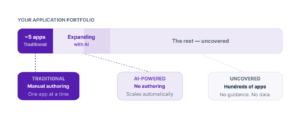
The first is scale. Industry benchmarks put unused software spend at roughly 25% of budgets, with 8% of organizations not tracking SaaS costs at all. Content authoring solves one application at a time. A portfolio of hundreds of applications, each with its own walkthrough library, creates a maintenance burden that scales linearly with the estate. Nobody is writing 300 walkthrough sets and keeping them up to date.
The second is AI proliferation. The Stanford HAI 2026 AI Index documented that organizational AI adoption reached 88%, with 70% using generative AI in at least one business function, but agent deployment remains in single digits across nearly every business function. Meanwhile, PagerDuty’s 2026 Shadow AI survey (Wakefield Research, 1,250 professionals at $500M+ firms, fielded April 2026) found that 66% of office professionals have used AI tools at work despite believing it was not permitted. Content authoring cannot govern tools it does not know exist.
The third is measurement pressure. McKinsey’s AI Trust survey (March 2026, ~500 organizations) found that only about one-third of organizations report maturity levels of three or higher in strategy, governance, and agentic AI governance. Boards want to see which investments deliver value. Content authoring answers “did we build the training?” It does not answer “did the training produce a measurable outcome?”
The category split
The in-app guidance category is diverging into two lanes, and the distinction matters for anyone writing an RFP or evaluating tools in 2026.
Lane one: content authoring and delivery. Walkthroughs, tooltips, announcements, simulations, checklists. The tools that help people complete tasks inside applications. This lane is mature, well-understood, and necessary. It is also where the legacy tools (uPerform, Oracle Guided Learning, HealthStream) and most existing in-app guidance platforms have historically competed.
Lane two: intelligence and measurement. Usage analytics across the application estate. Adoption scoring tied to business outcomes rather than training completions. Portfolio-level visibility into which applications earn their budget. Shadow IT and AI tool detection. Audit-grade evidence for compliance. This lane did not exist as a defined category five years ago. It’s shaping now.
Gartner’s 2025 Market Guide for Digital Adoption Platforms codified this shift, repositioning the category from in-application guidance platforms toward cross-application orchestration. Gartner’s strategic planning assumption: these platforms will increasingly function as orchestrators within an application ecosystem, coordinating AI agents and assistants across applications. That is a fundamentally different job description from “build a walkthrough.”
The concept emerging on the intelligence side is Application Intelligence: an analytics layer that combines application discovery (which apps are in use, including shadow IT), adoption scoring across multiple dimensions (not just logins, but happiness, efficiency, adoption, risk, and task success), and portfolio-level visibility that connects usage data to cost and risk. The measurement side uses frameworks like Userlane’s HEART (Happiness, Efficiency, Adoption, Risk, Task Success) to produce standardized, benchmarkable scores rather than the binary trained/not-trained signal that content authoring generates.
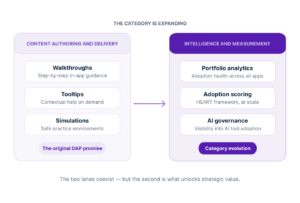
The delivery lane has not disappeared. Contextual Assistance, the in-app help that meets people where they work, remains essential. What has changed is that delivery without measurement is no longer a complete answer. If you cannot prove the walkthrough reduced errors, shortened time-to-proficiency, or improved task completion, the investment lacks the evidence a CFO requires.
What modern evaluation criteria look like
If you are evaluating tools in this space in 2026, the criteria have expanded beyond “can it build a walkthrough.” Here is what separates intelligence-era platforms from content-authoring-era tools:
- Cross-application measurement. Does the platform measure adoption and usage across the entire application estate, or only within applications where content has been authored? The difference determines whether you get portfolio visibility or isolated walkthrough analytics.
- Outcome-tied scoring. Does the platform connect usage to business outcomes (cost reduction, productivity, risk), or does it report activity metrics (logins, training completions, session counts)? Activity metrics tell you who showed up. Outcome scoring tells you what the software actually delivered.
- AI tool visibility. Can the platform detect which AI tools people use across the browser, including unsanctioned ones? With 66% of employees using AI tools outside policy (PagerDuty/Wakefield, 2026), browser-based AI detection is now a governance requirement, not a feature.
- Audit-grade evidence. Can the platform produce compliance-ready usage evidence? The EU AI Act’s transparency obligations take effect on 2 August 2026, with penalties of up to €35M or 7% of global turnover. Training completion certificates are not the evidence that regulators are asking for. Usage logs, adoption metrics, and human-oversight records are.
- Vendor independence. Does the platform work across any browser-based application, or is it locked to a single vendor’s ecosystem? Oracle Guided Learning works inside Oracle, uPerform works where it has been authored. Cross-application reach determines whether you get one view or twenty.
These criteria reflect how enterprise procurement is shifting. Gartner’s April 2026 IT spending forecast projects worldwide software spend at $1.44 trillion in 2026. GenAI features are now embedded across software already owned by enterprises, and every AI feature adds a line item. When every application costs more, the question “is it earning its budget?” becomes the procurement default.
For organizations in regulated industries, the Bitkom 2026 study adds urgency: 41% of German companies now actively use AI (doubled in a year), while 53% cite lack of know-how as their top barrier. A separate Bitkom survey found 69% of companies need help with AI Act compliance. The governance gap is not closing on its own.
The content authoring question has not gone away
If you are rolling out a new ERP module next quarter, you still need interactive guidance. If you are onboarding 200 nurses to a clinical system, you still need step-by-step guides in the application. Content authoring and delivery remain a necessary capability.
What has changed is that content authoring is now a subset of a bigger question. The Training Magazine 2025 Industry Report found that US training expenditures reached $102.8 billion, up 4.9%, while average training hours per employee fell from 47 to 40, and large-company training budgets declined from $13.3 million to $11.7 million. Organizations are spending more per learner on fewer hours, which means every hour of training needs to produce a measurable outcome.
Evaluation criteria that start with “can it build a guide” are solving yesterday’s problem. The question in 2026 is whether the platform can tell you, across your entire application estate, which investments deliver value and which do not, and produce the evidence to prove it. Content authoring is one input. Intelligence is the answer.

