

Twenty million. That is how many paid Microsoft 365 Copilot seats Microsoft reported in its Q3 FY26 earnings, a number CEO Satya Nadella said weekly engagement “is now at the same level as Outlook” as users “make Copilot a habit.” Set against Microsoft’s own installed base of over 450 million commercial seats, that is under 4.5% penetration. The number tells you something real about how much was sold. It tells you nothing about how much is used.
This is not a Copilot-specific problem. It is the defining measurement failure of enterprise AI in 2026: organizations are evaluating their AI investments with the same metric they used for traditional software, counting how many seats they deployed, and mistaking that for evidence of value.
The ROI question nobody can answer
Global corporate AI investment more than doubled in 2025 to $581.7 billion, according to the Stanford HAI 2026 AI Index. Microsoft alone reported an AI annual revenue run rate of $37 billion, up 123% year over year. Boards are not asking whether to invest in AI. They are asking what they got for the investment they already made.
Most cannot answer. A Thomson Reuters survey of more than 1,500 professionals across 26 countries found that only 18% of organizations track AI ROI at all. Roughly 40% do not even know whether the measurement is happening. The pressure, meanwhile, is intense: a Dataiku-commissioned Harris Poll of 600 CIOs found that 98% report increased board pressure to demonstrate measurable AI ROI, and 71% expect budgets frozen or cut by mid-2026 if they cannot deliver.
The result is a scramble for numbers. And the number most readily available, the license count, becomes the default.
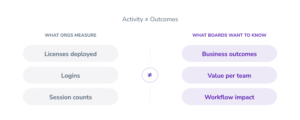
Why license math does not work for AI
Traditional enterprise software created a rough equivalence between deployment and use. If you provisioned 500 Workday licenses, most went to people whose job required the system. AI tools break that assumption in three ways:
- Access is not intent. Copilot Chat is available at no extra cost across Microsoft 365 plans, and the full Copilot add-on requires only a qualifying E3 or E5 base license to activate. Gemini is included in Google Workspace Business and Enterprise. Millions of knowledge workers have AI access they never asked for and may never use.
- Use is discretionary. Unlike an ERP system that staff must use to do their job, AI assistants are optional additions to existing workflows. Adoption depends on whether individuals find the tool useful for their specific tasks.
- Value varies wildly by role. A legal analyst drafting contract summaries may use AI daily. A project manager in the same organization may open it once and never return. Aggregate seat counts flatten that variance into a single meaningless number.
The default industry threshold for “active” Copilot use is a single interaction in 28 days. That is not adoption. It is a rounding error dressed as a metric.
The measurement gap, in numbers
The evidence that current ROI approaches are failing is broad and consistent:
- Only 28% of AI use cases in infrastructure and operations fully meet ROI expectations, with 20% failing outright, according to a Gartner survey of 782 I&O leaders.
- 31% of chief sales officers cited difficulty proving ROI of AI-driven tools as a top challenge for 2026, per a separate Gartner survey of 227 CSOs.
- 43% of organizations cite business value and ROI measurement as a top GenAI challenge, according to Futurum Group’s 1H 2026 AI Platforms survey of 820 decision-makers.
The Futurum data reveals something else worth noting. Among 830 IT decision-makers surveyed for their enterprise software report, productivity gains collapsed from 23.8% to 18.0% as the primary ROI metric. Direct financial impact, revenue growth and profitability, nearly doubled to 21.7%. The market is signaling that “save four hours per week” is no longer a credible justification. Boards want to see the P&L line.
The variance problem hiding inside aggregate numbers
Even when organizations do measure AI outcomes, averages conceal the real story. PwC’s 2026 AI Performance Study of 1,217 senior executives found that 74% of AI’s economic value is captured by just 20% of organizations. Leaders generate 7.2 times more value than the rest.
The difference is not how much AI they deployed. PwC estimates the technology itself delivers roughly 20% of an initiative’s value. The other 80% comes from workflow redesign, governance, reskilling, and, critically, outcome measurement. Organizations that only count seats are measuring the 20% that matters least.
Gartner’s Global Labor Market Survey of 12,004 employees across 40 countries confirmed the pattern at the individual level. Senior Director Analyst Swagatam Basu called it the “enablement illusion”: most leaders are mistaking basic access or adoption metrics for transformation. The illusion, Basu warned, is hiding risks and draining ROI. One telling data point: 19% of employees with AI access reported saving no time at all.
The governance blind spot
When organizations lack visibility into who actually uses AI tools, and how, the consequences extend beyond unproven spend. A CSA and Token Security survey of 418 IT and security professionals found that 82% of organizations had discovered AI agents or workflows that security or IT did not previously know about. More concerning: 65% had experienced an AI agent security incident in the past 12 months, with 61% reporting data exposure.
You cannot govern what you cannot see. And you cannot see what you are not measuring at the right level of depth.
What measurement should look like instead
The research converges on a clear direction. Gartner recommends what it calls a “True ROI Index” that measures depth and diversity of AI use, not breadth of deployment. The Return on AI Institute’s survey of 1,006 senior executives identified seven factors that reliably drive economic value from AI, none of which are captured by license counts.
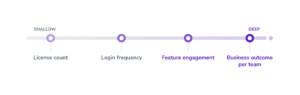
The shift required is from deployment metrics to adoption intelligence:
- Who uses it, by team and role. Not how many seats were provisioned, but which teams have integrated AI into daily workflows and which have not.
- What they use it for. Feature-level engagement data that distinguishes meaningful use from a single curious interaction in 28 days.
- What business outcome it connects to. Time saved matters only if it translates to measurable financial impact: fewer tickets, faster cycle times, reduced error rates, lower training costs.
- Where adoption stalls, and why. Team-level patterns that reveal whether the barrier is awareness, training, workflow fit, or tool quality.
This is the kind of measurement that separates the 20% of organizations capturing real value from the 80% still counting seats. The question is not whether your enterprise has AI. It is whether you can prove your enterprise uses it.

