

Every department bought its own AI. Nobody bought visibility into what any of it does.
Nobody owns this problem
Somewhere between the third ChatGPT subscription and the fifth Copilot pilot, most enterprises lost count. Not of money (that shows up eventually) but of tools: who bought what, who uses it, and whether any of it overlaps with something the organization already pays for.
This is the quiet part of the AI investment story. It is predicted that global AI spending will hit $2.59 trillion in 2026, up 47% year over year, according to Gartner. Eighty-eight percent of organizations use AI in at least one business function. The adoption curve looks like a success story. The governance curve tells a different one: McKinsey’s 2025 survey found that 51% of organizations reported at least one negative consequence from AI use in the past twelve months, with inaccuracy leading the list.
The gap between how fast organizations adopt AI tools and how slowly they govern them has a name: AI tool sprawl. The problem behind the gap is not the technology itself, it’s a visibility issue with a compounding price tag.
The budget that funds itself on fiction
You have probably seen the pattern. A team requests budget for an AI tool, justifies it against projected cost savings, and gets approval faster than any other software category. Bain’s 2026 Pathfinder Survey quantified this: across 951 companies, 44% cited savings from prior automation programs as their top funding source for generative AI (GenAI) and agentic AI investments, even as prior-wave savings came in below target. The budget grows, but if the savings arrived or not – nobody knows.
This creates a compounding problem: each purchase justifies the next, and none of them are measured against actual outcomes. Gartner estimates that up to $234 billion in enterprise application spending is exposed to displacement by agentic AI by 2030. That is roughly 20% of enterprise application software-as-a-service (SaaS) spending at risk of redundancy as AI agents replicate functions organizations already pay for through conventional software.
Meanwhile, most of the AI activity inside your organization does not touch procurement at all. IDC’s 2025 Global Employee Survey found that only 23% of EMEA employees use AI tools provided by their organization. Another 39% use free tools. Seventeen percent pay out of pocket. The majority of enterprise AI usage runs outside any contract, any security review, any license reconciliation, creating a potential governance and data security issue.
Compliance exposure with no return address
Cost is recoverable. Compliance failures are not.
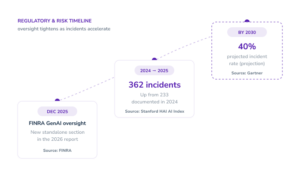
A Gartner survey of 302 cybersecurity leaders found that 69% of organizations suspect or have confirmed that employees use prohibited public GenAI tools. Gartner projects that by 2030, more than 40% of enterprises will experience a security or compliance incident linked directly to shadow AI. The trajectory is already visible: the Stanford HAI 2026 AI Index reports that documented AI incidents rose from 233 in 2024 to 362 in 2025. A 55% increase in one year.
Regulators are responding accordingly. FINRA’s 2026 Annual Regulatory Oversight Report includes its first dedicated GenAI section, applying existing supervisory obligations to AI-generated output. The principle is technology-neutral: firms remain fully responsible for compliance regardless of which tool produced the work. A financial advisor who uses an unsanctioned chatbot to draft client communications creates the same regulatory exposure as one who manually fabricates the content. The tool changes. The liability does not.
The breach premium is already priced
When ungoverned AI tools lead to a data breach, the cost is not theoretical. The Ponemon Institute’s 2026 Cost of Insider Risks report puts negligence-driven insider losses at $10.3 million per organization annually, a 17% year-over-year increase. The per-incident cost: $747,107. Healthcare and pharmaceutical organizations sit at the top, with $28.8 million in average annual insider-risk losses. Shadow AI is identified as a key contributor to the rise in negligence-driven incidents.
The governance infrastructure to contain this risk is barely in place. ISACA’s 2026 Pulse Poll of 3,400 digital-trust professionals found that 90% report employees using AI in their organization. Only 38% have a comprehensive AI policy. Just 12% have a documented, tested process to shut down or override an AI system during an incident. Nine in ten organizations have the exposure. Fewer than four in ten have the controls.
Three questions that separate governance from guesswork
If you are responsible for an enterprise software portfolio, the difference between managed AI adoption and unpriced liability comes down to three questions:
- Visibility: Can you name every AI tool in use across the organization, including browser-based services employees adopted without a procurement request?
- Cost attribution: Can you connect AI spending to measurable business outcomes rather than to project approvals built on savings that never materialized?
- Compliance mapping: Can you demonstrate, under audit, which AI tools process regulated data and under what contractual terms?
Most organizations cannot answer any of these with confidence. The tools to answer them exist, but the organizational habit of asking does not.
Restricting access is not the answer. Gartner’s AI agent sprawl guidance warns explicitly that heavy restriction pushes employees toward shadow AI, which carries greater risk than sanctioned tools used without optimization. The path forward is visibility first, cost-to-outcome connection second, compliance controls layered on a foundation you can actually see.
The organizations still guessing will keep paying for the privilege. The invoices do not wait for the governance to catch up.

