
Organizations spend $1.44 trillion on software annually. Most cannot tell you which of those investments deliver value.
Most enterprise technology conversations start with spending. Gartner’s April 2026 forecast projects $1.44 trillion in global software spend this year, growing 15.1%. AI spending alone will reach $2.59 trillion, up 47% year over year. The numbers keep climbing. The visibility does not.
Here is the gap: organizations are aware of only 30 to 50% of the applications their people actually use, with up to 30% of licenses sitting unused or underused. Most IT leaders know what they bought. Few know what gets used, by whom, or whether it produces anything the business would call value.
The issue is not how much organizations spend. It is how little they know about whether any of it works.
What Application Intelligence is
Application Intelligence is the analytics layer that shows how enterprise software and AI tools are actually used, where they create value, and where they create cost or risk.
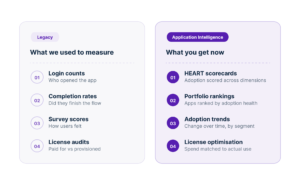
Userlane defines Application Intelligence as a category of capability that legacy measurement approaches do not cover. Where login tracking, training completion rates, and satisfaction surveys measure activity, Application Intelligence measures outcomes: whether the software justifies its cost, whether people use it well, and whether adoption improves or declines over time.
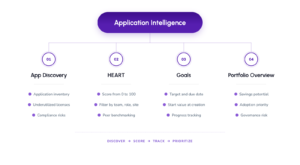
Userlane’s Application Intelligence combines four core capabilities:
- App Discovery. Maps every application and browser-based AI tool people use across the organization, including shadow IT and unsanctioned AI services. Produces an application inventory with usage data, identifies underutilized licenses, and flags compliance risks.
- HEART Score. A five-dimensional model (Happiness, Efficiency, Adoption, Risk, and Task Success) that quantifies whether applications deliver value. Each application receives a HEART scorecard with a HEART Score (0 to 100). Scores can be filtered by department, role, and site, making it possible to compare performance across teams and benchmark against peer organizations running the same application category.
- Goals. Turns expected outcomes into time-bound, measurable commitments tracked against Userlane data. Each goal has a target, a due date, and a start value captured automatically the moment the goal is created, so progress is measured from a fixed starting point. Goals can be scoped to a specific audience, and each goal shows its related HEART dimension so teams can investigate what drives progress. Where the HEART Score shows whether an application is earning its place, Goals shows whether it delivers what the business case promised.
- Portfolio Overview. Rolls up HEART Scores, adoption data, cost, and risk across the entire application estate so budget owners can see where to save on licenses, focus adoption efforts, plan change, and govern AI.
What legacy measurement misses
If you manage enterprise software today, your measurement stack probably includes some combination of login counts, LMS completion rates, periodic satisfaction surveys, and annual license audits. These are activity metrics. They tell you someone showed up. They do not tell you whether the software works.
The gap between what organizations measure and what they need to know is well documented. A Gartner survey of over 3,100 CIOs found that only 48% of digital initiatives meet or exceed their business outcome targets. The failure is rarely technical: the software works, but nobody measured whether it delivered results. Separately, Gartner’s research on business value communication shows that while 67% of organizations say they define value with stakeholders at least annually, only 22% have a standardized process for mapping IT spend to business outcomes.
Application Intelligence replaces this measurement gap with continuous, outcome-oriented data. Instead of asking “did people log in?” it answers: which features do they actually use? Where do they get stuck? How does adoption vary by team, role, and location? Does the application justify its license cost? These are the questions that appear on a CIO’s scorecard and a CFO’s renewal decision.
Measurement that leads somewhere
Measurement without action is a dashboard nobody opens. Application Intelligence is designed as one half of a closed loop. The other half is Contextual Assistance: In-app Guidance, the Assistant, and automation delivered inside the application at the moment someone needs it.
The loop works in three steps. Application Intelligence identifies where software creates friction: a department with low HEART Scores on a critical application, a feature that 80% of users abandon, an AI tool that no one uses despite active licenses. Contextual Assistance delivers targeted intervention: workflow guidance, in-app prompts, or automated support. Application Intelligence then measures whether the intervention worked, with Goals tracking progress against the target set at the start, and the cycle repeats.
Measure, act, prove. That sequence is what separates an analytics layer from a reporting tool.
Why it matters now
Three forces make the visibility gap more expensive than it was five years ago.
Software estates are larger. Productiv’s analysis of nearly 100 million SaaS licenses found that organizations use an average of 371 applications, with over 50% of licenses going unused. Each new application adds to the measurement debt.
AI tools are multiplying faster than organizations can track them. McKinsey’s 2025 State of AI report found that 88% of organizations now use AI in at least one function, but only about one-third have scaled beyond pilots. Gartner predicts that 40% of enterprise applications will embed task-specific AI agents by the end of 2026, up from less than 5% in 2025. AI tools are entering the estate faster than legacy measurement can keep up with.
The ROI pressure is real. PwC’s 2026 Global CEO Survey of over 4 thousand CEOs found that 56% report no significant financial benefit from AI investments to date. Gartner’s John-David Lovelock observed in May 2026 that because organizations “favor tactical AI initiatives,” CIOs face challenges proving the value from AI investments and demonstrating tangible business outcomes. The question is no longer whether to invest in software and AI. It is whether you can prove the investment works.
Application Intelligence exists because the gap between what organizations spend on technology and what they know about its performance is now too expensive to leave unmeasured. The organizations that close it will make better decisions about where to invest, where to cut, and where to help people get more from the tools they already have. The ones that do not will keep buying software they cannot prove works.

