
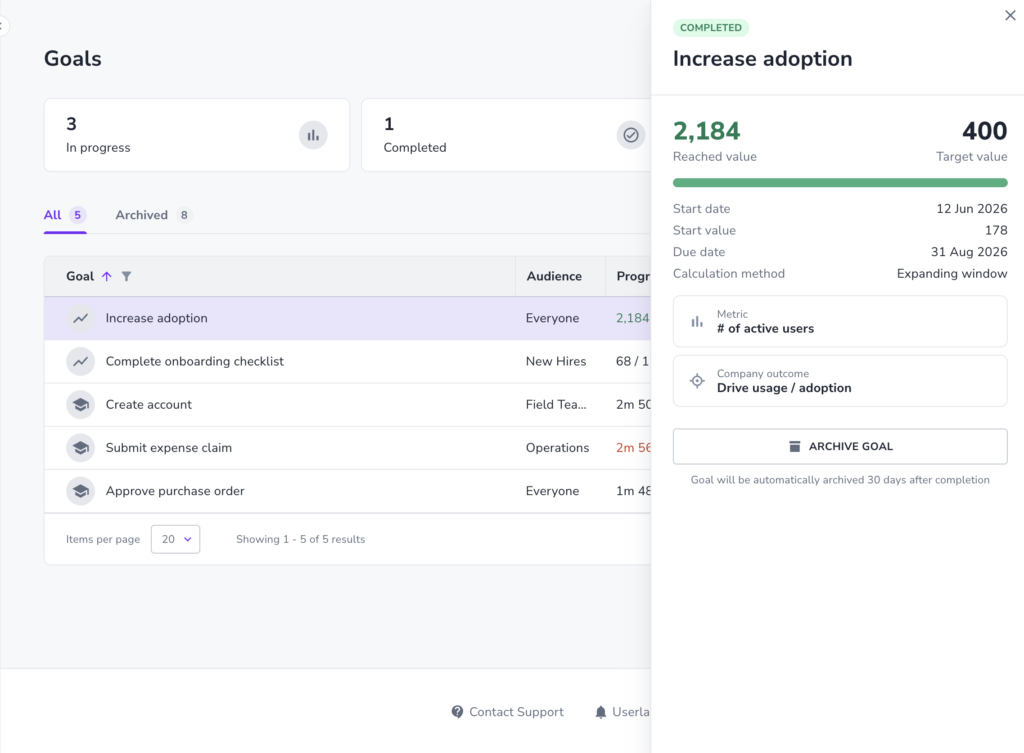
Goals captures a baseline the moment you set a target and tracks progress daily, so the evidence exists when someone asks whether the investment worked.
A software rollout gets approved on a business case with specific commitments: training completion reaches 90% by Q2, support tickets drop 30% within a year, active users hit a threshold within 90 days of go-live. The targets make the investment measurable in principle. In practice, when the review meeting arrives six months later and someone asks whether the program delivered, answering is harder than it should be. The targets were clear. The baseline, and the structured trail from there to here, usually was not.
Goals adds that structure. The team defines what it committed to, Userlane captures where things stand today, and progress tracks daily from that point forward.
What Goals are
Userlane already measures whether applications are delivering (through the HEART Score) and shows where to focus across the portfolio (through Portfolio Overview). Goals adds the missing piece: a way to set a specific target against that data and track whether it was hit.
Goals reads from the same usage data as the HEART Score, but everything about a goal is configured by the team that owns it: the outcome area, the target value, the deadline, and (optionally) the user segment. Where the HEART Score measures whether the application is earning its place, Goals tracks whether a specific commitment is on target.
Between measurement and proof sits the action. When a goal shows a gap between the baseline and the target, Userlane’s Contextual Assistance acts on that gap inside the application: a guide targeting the users who are not active, a validator catching data entry errors, the assistant helping someone complete a workflow they abandoned. Goals then tracks whether the action worked. That is the loop: measure, act, prove. Goals is where the proof lives.
How goal creation works
You start by choosing an outcome, not a metric. Userlane provides a library of pre-built goals covering the outcomes software programs are measured against. Each goal in the library comes with a fixed measurement, so you pick the outcome and the tracking follows.
From there you narrow it: name the goal, choose the specific workflows or content it covers, set a target value and a deadline, and optionally scope it to a user segment. If your business case says support tickets drop 30% by Q2 for the finance team, that is what the goal captures.
The moment a goal is saved, Userlane records the current value as the baseline. That means creation timing matters: you set the goal before the intervention starts, not after. Progress tracks daily from that point, so the evidence is structured from the start rather than reconstructed later. What counts as success is defined by the team, not by the platform.
Goals covers browser-delivered applications and browser-based AI tools.
What happens after a goal is set
Progress refreshes once daily. Each goal sits in one of four states: in progress, completed, overdue, or archived. When the deadline passes without hitting the target, Userlane marks the goal overdue rather than letting it pass quietly. Completed goals are preserved with the baseline, the target, and the final value on the record.
What Goals changes in practice
Without Goals, proving whether a rollout delivered means pulling data from multiple sources after the fact and hoping the numbers line up with the original business case. With Goals, three things change.
The review meeting gets shorter. The baseline, the target, and the current state are already structured. There is no reconstruction step.
The renewal conversation has evidence. A goal that moved from baseline to target is a documented outcome. A goal that did not move is a documented signal to investigate, not an opinion about whether things went well.
Planning improves over time. Archived goals show which targets were realistic and which were not. The next rollout’s business case can reference what actually happened, rather than starting from assumptions again.
Related reading
The HEART Score: measure adoption, catch compliance gaps, prove the investment
Beyond completion rates: what software adoption metrics actually tell you

