

Enterprise software adoption takes longer than implementation. The gap between contract end and value capture is where implementation firms leave their highest-margin revenue uncaptured.
The contract ends. Adoption hasn’t started.
Most enterprise software implementations have the same structural flaw built into their commercial models: the contract defines go-live as the finish line, but the adoption curve does not inflect until months after the consultants have left.
Gartner predicts that by 2027, more than 70% of recently implemented ERP initiatives will fail to fully meet their original business goals, with as many as 25% failing catastrophically. The failures are not random. They cluster in a specific phase: the months after deployment, when the implementation team has moved on and the organization is left to realize value from software it has not yet learned to use.
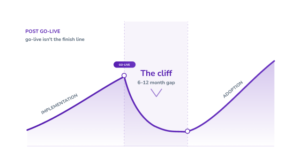
If you run an implementation practice, this gap is your problem and your opportunity. The cliff is not a support issue. It is a revenue phase that most implementation firms are not structured to capture.
What adoption actually looks like after go-live
The evidence across software categories tells a consistent story: go-live is where the implementation contract ends, not where value begins.
Panorama Consulting Group’s 2026 ERP Report found an average project timeline of nine months, with more than a quarter of organizations exceeding their budget and nearly a quarter going over schedule. The primary cause was not software defects: it was organizational issues, with few companies reporting an intense focus on organizational change management. Benefits data in the report was drawn only from respondents with at least one phase live for at least a year. That is the minimum timeline for measurable value to emerge, and by then the implementation partner is already gone.
Healthcare makes the pattern concrete. KLAS Research’s EHR Implementations 2025 report found that just 38% of organizations said their recent EHR implementation hit the mark, with satisfaction dropping consistently since 2022. Their Clinician EHR Experience 2025 report found that only 18% of physicians report a strong or elite EHR experience. The systems went live. The adoption never caught up.
The pattern extends well beyond healthcare and ERP. BCG’s 2025 study of more than 1,250 firms found that 60% are not achieving material value from their AI investments despite substantial spending, with only 5% capturing value at scale. McKinsey’s State of AI 2025 survey reinforced this: 88% of respondents use AI in at least one function, but only 39% report enterprise-level financial impact. The largest differences between leaders and laggards were not in technology selection. They were in adoption and scaling.
The budget nobody owns
Post-go-live optimization spend sits in a structural no man’s land. IT owns the system, operations owns the workflows, and the implementation partner’s SOW expired at go-live. Nobody owns the adoption gap.
Panorama’s research frames go-live as the start of value realization, not the end of the project. Their 2026 report confirms that demand is shifting: year-over-year growth in requests for post-implementation services, benefits realization support, organizational change management guidance, and business process management. The budget for it is fragmented across IT, operations, and the vendor’s support contract.
Deloitte’s 2025 Tech Value Survey found that nearly 60% of respondents believe another 21-50% of enterprise value from their digital investments remains latent. The cost of leaving it there compounds. A peer-reviewed study published in the Project Management Journal in 2025, analyzing more than 11,000 IT projects across 23 types, found a mean cost overrun of 73%, with an 18% probability of landing in the extreme tail where the expected overrun reaches 453%. IT projects had the worst cost-risk profile of all 23 project types examined. These overruns do not end at go-live. They extend into the months and years when organizations pay for systems that have not yet delivered on their business case.
Why the post-go-live service model is worth building
Deloitte’s AI ROI study from 2025 found that most organizations achieve satisfactory ROI on technology investments within two to four years. Only 6% reported payback in under a year. Even among the most successful projects, just 13% saw returns within 12 months.
That timeline tells the commercial story: if value realization takes two to four years and the implementation contract ends at go-live, the highest-value phase of the engagement happens after the partner has already walked away.
KLAS Research’s EHR Clinical Optimization 2025 report documented steady growth in optimization engagements since 2018. That growth did not come from new implementations: it came from provider organizations discovering that go-live was not the finish line. The capital markets agree. The 2026 acquisition of Pivot Point Consulting by Innovative Consulting Group signals that investors see recurring-revenue healthcare IT services as the growth thesis.
What a post-go-live service model could look like
The implementation firms capturing this revenue are building structured post-go-live practices around four capabilities:
- Adoption monitoring: measuring which features are used, which are abandoned, and where workflows break down after deployment
- Optimization sprints: targeted interventions (typically 4-8 week cycles) that address specific adoption gaps identified through usage data
- Workflow analytics: continuous measurement of how software is used in practice versus how it was designed to be used
- Continuous enablement: ongoing training and support calibrated to actual usage patterns rather than pre-go-live assumptions
None of these are one-time projects. Each can be structured as a recurring engagement with measurable outcomes the client can tie to their original business case. Analytics surfaces the gap, intervention closes it, and the next measurement cycle surfaces the next gap.
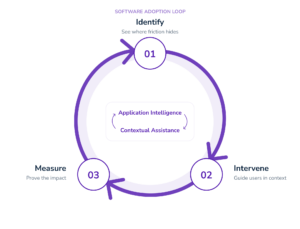
If you run an implementation practice, the strategic question is not which go-live comes next. It is whether you own what happens after. The post-go-live margin opportunity in healthcare IT applies equally to ERP, CRM, and every other enterprise software category where the contract ends before adoption starts.
The cliff is a revenue phase, not a problem to solve later
The 6-18 month window after go-live is not an afterthought. It is the phase where the client’s investment either converts into outcomes or decays into shelfware. Implementation firms that plan for this phase before the contract is signed will capture the highest-margin, most defensible revenue their industry has to offer. The ones that walk away at go-live are leaving it for someone else.

