
Reducing new hire onboarding time in consulting firms
Improve Time-to-Productivity

Onboard Challenge
New hire onboarding time in consulting firms is reducible at the point where the delay actually occurs: inside the applications the consultant needs to learn. Most firms invest in classroom sessions and orientation decks that do not cover the systems where the work happens.
A new consultant joining a firm needs to operate across multiple systems from the first week: the time and expense platform (for billing), the Customer Relationship Management (CRM) system (for client records), the Human Resources Information System (HRIS) (for benefits and payroll), and the project management or resource planning tool (for engagements). Each application has its own navigation, its own field conventions, and its own data dependencies. Completing a task in one system often requires data entered correctly in another.
The delays follow predictable patterns. A new consultant spends the first two weeks asking colleagues how to submit time entries, where to find project codes, and which system holds the client’s engagement history. A time entry is rejected because the project code format differs between the ERP and the resource planning tool. An expense report is filed against the wrong engagement because the consultant looked up the client in CRM but entered the expense in the ERP using a different project identifier. A lateral hire with experience at another firm navigates one system confidently but has never seen the firm’s specific time entry workflow. These are not learning curve problems that resolve on their own. Each system’s complexity is manageable individually. The difficulty is the sequence and the dependencies across systems, and classroom onboarding cannot replicate what happens when the consultant sits down to do the actual work.

Our Solution
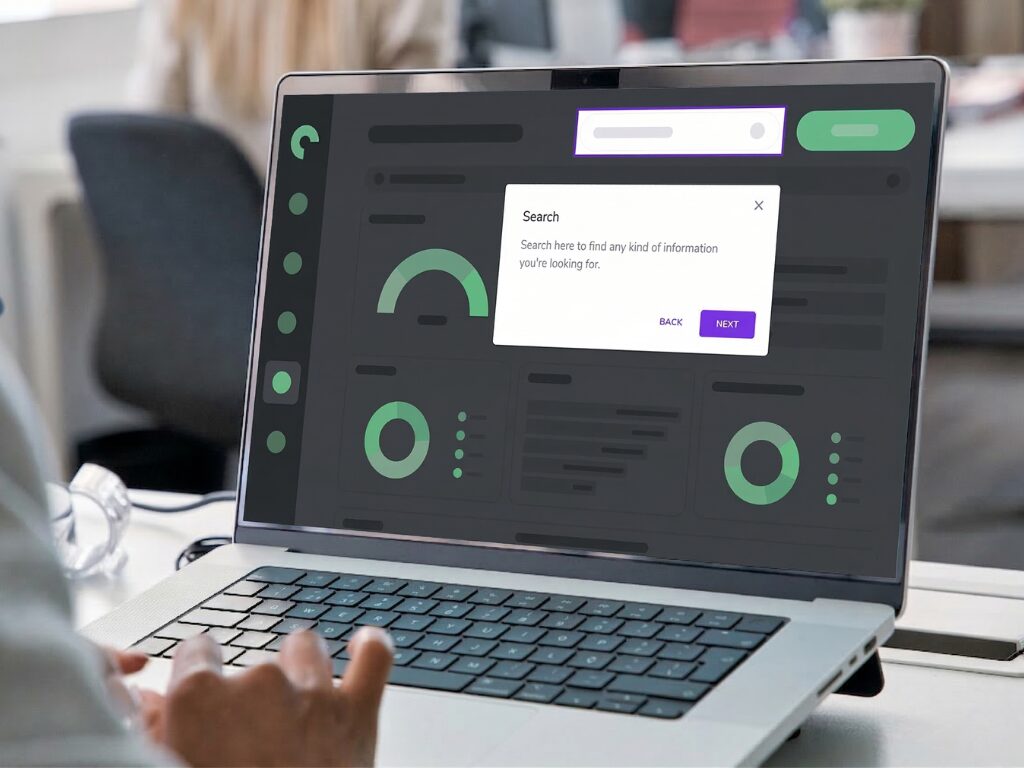
Userlane is a software adoption platform that works inside browser-based applications. For consulting firm onboarding, it reduces time-to-productivity where the delay starts: inside each application, during the consultant’s first real tasks.
Walking new hires through each system
In-app guidance walks new consultants through the workflows they need in each application: submitting time entries in the ERP, locating client records in the CRM, enrolling in benefits through the HRIS, and finding project assignments in the resource planning tool. Each guide runs inside the application itself, in the sequence the consultant needs. No separate training portal, no PDF, no classroom session to remember two weeks later.
Catching common entry errors across systems
Validators check fields where new consultants make predictable errors: project codes that do not match the expected format, time entries with missing billing categories, expense line items filed against the wrong engagement. Each error is flagged before the record is saved, not caught by a reviewer days later.
Tracking time to productivity
The HEART Score, Userlane’s application health metric, tracks how quickly new consultants complete core tasks correctly on their own. The onboarding team sees the breakdown by practice area, office location, and hire type (graduate vs. lateral): where consultants reach proficiency quickly and where the gap persists.
Measure. Act. Prove.
Every deployment follows the same cycle. Measurement comes first, intervention second, proof third. The cycle repeats with each new workflow.
Measure
Userlane records every new hire interaction across each onboarded application before any intervention starts. The data shows where time-to-productivity stalls, so the team acts on evidence, not assumptions.
The HEART Score captures the baseline. Every task attempt by a new hire is recorded: which workflows are completed on the first try, which require multiple attempts, and where consultants abandon the task and ask a colleague instead. Nothing changes for the new hires. Each application works exactly as before.
A pattern emerges. Graduate hires take three times longer than lateral hires to submit their first correct time entry. One practice area reaches proficiency in the CRM within a week; another takes four weeks. New consultants in every office struggle with the same expense report workflow. The HEART Score puts a single number on each application’s onboarding health.
The team sees the real problem. Not “new hires need more onboarding training.” One application has a confusing project code lookup. One workflow has a dependency on a field in a different system that the classroom session never covered. The intervention writes itself.
Act
In-app guidance and Validators deploy only where the measurement found delays. Targeting the intervention is what makes the result provable.
In-app guidance activates. Only where onboarding stalls. A confusing time entry workflow gets step-by-step contextual help. The CRM’s client lookup that new hires cannot find gets a guided prompt on first use. Applications where new hires reach proficiency quickly see no change.
Validators catch entry errors. Project code mismatches, missing billing categories, expense entries against the wrong engagement: each is flagged before the record is saved. Errors that experienced consultants rarely make trigger no validation.
The intervention stays proportional. Graduate hires get guidance that lateral hires skip. Practice areas with fast onboarding times are left alone. Workflows that new hires complete correctly on the first attempt trigger nothing.
Prove
The same measurement that found the problem now tracks whether the fix worked. A shorter time to first correct task completion, confirmed against the firm’s own onboarding metrics, closes the loop.
The HEART Score moves. The same measurement that found the problem now tracks the fix. Task completion times and error rates by practice area, office, and hire type show whether the intervention worked.
Results track against the target. The goal the onboarding team set before the intervention tracks automatically. The quarterly partner review gets a before-and-after built from live data, not a separate report.
The cycle starts over. The firm migrates its expense system. A new practice area launches with its own project management tool. The HEART Score flags a dip. Measure, act, prove runs again. The infrastructure is already there.
Proven Impact
When in-app guidance and Validators replace classroom sessions and orientation PDFs for new hire onboarding across the firm's application portfolio, the results show in the firm's own data: shorter time to first billable task, lower support volume from new hires, and fewer entry errors reaching the finance team.
Up to 97% task completion
Task completion rate across enterprise deployments
Up to 75% training time reduction
Reduction in training time for new staff
Up to 48% fewer support requests
Fewer support requests after deployment
Up to 60% lower training costs
Lower training costs vs. classroom methods
Frequently Asked Questions

