
Reducing discharge documentation time
Improve Time-to-Productivity

Speed Challenge
Discharge documentation takes longer than it should because the Electronic Health Record (EHR) spreads the task across multiple screens, modules, and save points. Most of that time is navigation, not clinical decision-making.
A clinician completing a discharge works through the discharge summary, medication reconciliation, follow-up orders, and patient education materials. Each module has its own required fields, its own save logic, and its own incomplete-record warnings. A physician who discovers a missing home medication mid-process goes back, corrects it, and restarts follow-up orders from scratch when the session times out.
A discharge that should take 20 minutes takes 45. Beds stay occupied while the emergency department holds admitted patients waiting on upstream documentation. The clinician knows what needs to happen. The EHR does not help them do it in sequence, and classroom training does not survive the first system update.

Our Solution
Userlane is a software adoption platform that works inside browser-based applications. For discharge documentation workflows, it reduces the time from decision-to-discharge to completed documentation by guiding clinicians through the steps in sequence and catching incomplete fields before they cause rework.
Guiding the discharge sequence
In-app guidance walks clinicians through discharge documentation in the order that prevents backtracking: medication reconciliation first, then the discharge summary, then follow-up orders. Complex scenarios (controlled substance prescriptions, specialist referral letters, patient-specific education materials) get contextual help inside the EHR. The guidance replaces the laminated card on the workstation and the PDF on the shared drive.
Catching incomplete fields before they cause delays
Validators check each required field as the clinician completes it. A missing follow-up appointment, an unsigned reconciliation, a patient education form left at default: each is flagged before the clinician moves to the next screen, not found during bed management review hours later.
Measuring documentation speed
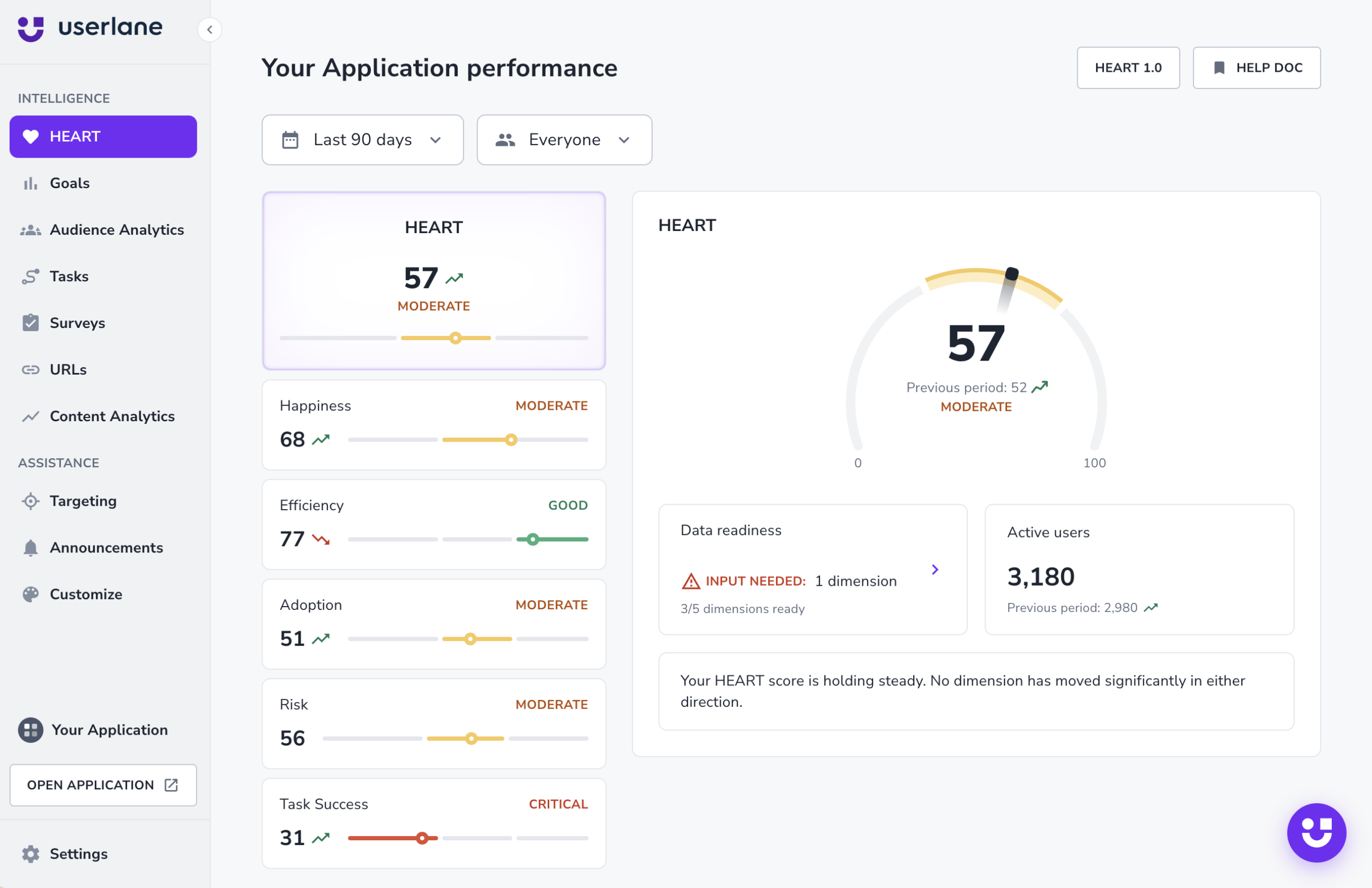
The HEART Score, Userlane’s application health metric, tracks discharge documentation efficiency: time to completion, first-attempt completion rate, and rework frequency. The clinical informatics team sees the breakdown by department and clinician cohort: where documentation improved and where bottlenecks remain.
Measure. Act. Prove.
Every deployment follows the same cycle. Measurement comes first, intervention second, proof third. The cycle repeats with each new workflow.
Measure
Userlane records every discharge documentation session before any intervention starts. The data shows where time is lost, so the team acts on evidence, not assumptions.
The clock starts running. Every discharge documentation session is recorded: how long each module takes, where clinicians navigate back, which fields trigger rework. Nothing changes for the clinical staff. The EHR works exactly as before.
A pattern emerges. Medication reconciliation takes three times longer on surgical wards than medical wards. Follow-up order entry stalls when the referral form requires a fax number the clinician does not have. New registrars spend 12 minutes on a workflow that experienced attendings complete in four. The HEART Score puts a single number on the workflow’s health.
The team sees the real problem. Not “everyone is slow at discharges.” Two modules consume most of the documentation time. The intervention writes itself.
Act
In-app guidance and Validators deploy only where the measurement found delays. Targeting the intervention is what makes the result provable.
Guidance activates. Only where delays concentrate. The discharge sequence is restructured so medication reconciliation completes before the summary, eliminating the most common backtracking loop. Clinicians who have completed fewer than ten discharges get step-by-step guidance. Experienced staff see nothing.
Validators catch the gaps in real time. A missing follow-up appointment, an unsigned medication list, a patient education form left at default: each is flagged before the clinician leaves the screen. No bed management review needed to find the incomplete record.
The intervention stays proportional. Departments with long documentation times get guidance. Departments already completing discharges efficiently are left alone. Weekend and evening shifts, where locum staff document less frequently, get extra support that day-shift regulars never see.
Prove
The same measurement that found the problem now tracks whether the fix worked. A falling time-to-completion figure, confirmed against the hospital’s own bed turnover data, closes the loop.
The HEART Score moves. The same measurement that found the delays now tracks the fix. Documentation time by department, shift, and clinician cohort shows whether the intervention worked.
Results track against the target. The goal the team set before the intervention tracks automatically. The quarterly review gets a before-and-after built from live data, not a separate report.
The cycle starts over. The EHR vendor releases an update that changes the discharge summary layout. Documentation time spikes on two wards. The HEART Score flags the dip. Measure, act, prove runs again. The infrastructure is already there.
Proven Impact
When in-app guidance and Validators replace classroom training and reference PDFs on discharge documentation workflows, the results show in the hospital’s own systems: shorter time from decision-to-discharge to completed documentation, fewer incomplete records flagged during bed management review, and faster bed turnover.
Up to 97%
Task completion rate across enterprise deployments
Up to 75%
Reduction in training time for new staff
Up to 48%
Fewer support requests after deployment
Up to 60%
Lower training costs vs. classroom methods
Frequently Asked Questions

