
Preventing medication documentation errors in MAR
Ensure Data Quality

Safety Challenge
Medication documentation errors in the Medication Administration Record (MAR) are preventable at the point of entry. Most Electronic Health Record (EHR) systems do not prevent them.
Every time a nurse documents a dose, they cross-reference drug name, dose, route, time, and patient identity across three screens: the pharmacy module, the patient record, and the MAR. Each field is a point where an error can enter.
The errors follow predictable patterns. A dose entered in the wrong unit. A route left blank because the field sits below the fold. A time recorded in the wrong format and silently accepted. These are not knowledge failures. The nurse knows the correct dose. The EHR does not stop the wrong entry, and classroom training cannot close a gap that reopens with every system update, every new starter, and every shift handover.

Our Solution
Userlane is a software adoption platform that works inside browser-based applications. For MAR workflows, it catches documentation errors where they happen: inside the EHR, during the task itself.
Preventing errors before they are saved
Validators check each medication entry as the nurse completes it. Wrong time formats, doses outside the expected range, missing route fields: each is flagged before the record is saved, not found during chart review hours later.
Guiding the correct workflow
In-app guidance walks clinical staff through complex medication scenarios inside the EHR: pro re nata (PRN) doses, controlled substances, multi-step infusions. It replaces the reference card pinned to the monitor and the PDF on the shared drive.
Tracking what changed
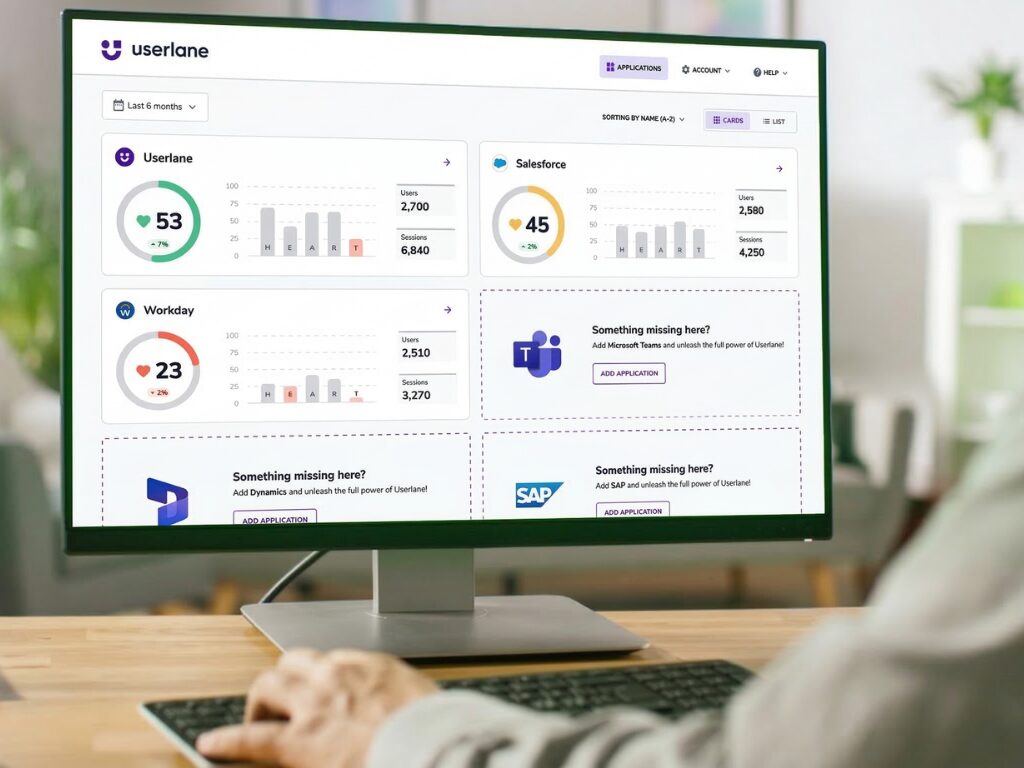
The HEART Score, Userlane’s application health metric, tracks the share of entries completed correctly on the first attempt. The clinical informatics team sees the breakdown by ward and shift pattern: what improved and where the gaps remain.
Measure. Act. Prove.
Every deployment follows the same cycle. Measurement comes first, intervention second, proof third. The cycle repeats with each new workflow.
Measure
Userlane records every MAR entry before any intervention starts. The data shows where errors concentrate, so the team acts on evidence, not assumptions.
Validators observe. Every MAR entry is recorded: which fields pass, which fail, where staff work around the system. Nothing changes for the nurses. The EHR works exactly as before.
A pattern emerges. Night-shift entries fail at three times the day-shift rate. PRN routes are left blank on one ward but not another. New starters struggle with the same two fields for weeks. The HEART Score puts a single number on each workflow’s health.
The team sees the real problem. Not “everyone needs more training.” Three wards need help with one specific field. The intervention writes itself.
Act
Validators and guidance deploy only where the measurement found errors. Targeting the intervention is what makes the result provable.
Validators activate. Only where errors concentrate. A wrong time format, a dose outside the expected range, a missing route: each is flagged before the record is saved. Wards with low error rates see no change.
Guidance meets staff in the workflow. Complex scenarios (PRN doses, controlled substances, multi-step infusions) get contextual help inside the EHR. No classroom session, no PDF. The help is where the work is.
The intervention stays proportional. High-error wards get support. Low-error wards are left alone. New starters get onboarding help that experienced staff never see.
Prove
The same measurement that found the problem now tracks whether the fix worked. A rising pass rate, confirmed against the trust’s own incident data, closes the loop.
The HEART Score moves. The same measurement that found the problem now tracks the fix. Validator pass rates by ward, shift, and cohort show whether the intervention worked.
Results track against the target. The goal the team set before the intervention tracks automatically. The quarterly review gets a before-and-after built from live data, not a separate report.
The cycle starts over. A system update changes the infusion workflow. The HEART Score flags a dip. Measure, act, prove runs again. The infrastructure is already there.
Proven Impact
When Validators and in-app guidance replace classroom training and reference PDFs on medication documentation workflows, the results show in the trust’s own systems: fewer errors reaching the pharmacy, lower support volume from clinical floors, and shorter time to competency for new starters.
Up to 97%
Task completion rate across enterprise deployments
Up to 75%
Reduction in training time for new staff
Up to 48%
Fewer support requests after deployment
Up to 60%
Lower training costs vs. classroom methods
Frequently Asked Questions

