
Increasing compliance training completion rates
Drive Change & Engagement

Comply Challenge
Compliance training completion gaps are detectable before the regulatory deadline passes. Most Learning Management Systems (LMS) surface them too late to act.
Every compliance cycle follows the same sequence: the learning and development team assigns training modules, staff receive notifications, and a deadline starts counting down. Each module has a regulatory consequence if missed. Annual mandatory courses, role-specific certifications, and policy refreshers all carry different deadlines, completion requirements, and consequences.
The gaps follow predictable patterns. Annual mandatory training is assigned in bulk, completed by the same early adopters, and untouched by the same departments until deadline week. A module requiring attestation is started but not submitted because the final confirmation screen is buried in the LMS interface. New starters receive their training assignments during onboarding but do not find them in the LMS until a colleague shows them where to look. These are not motivation failures. The staff member intends to complete the training. The LMS does not make completion straightforward, and email reminders cannot close a gap that reopens with every new hire, every new regulation, and every system update.

Our Solution
Userlane is a software adoption platform that works inside browser-based applications. For compliance training workflows, it moves completion to where the gap starts: inside the LMS, during the task itself.
Walking staff through the training workflow
In-app guidance shows staff where to find their assigned modules, how to navigate multi-step courses, and where to submit the final attestation. Each step runs inside the LMS, not in a separate system or an email link. Staff who have completed similar modules before see nothing.
Tracking completion against regulatory deadlines
Goals set completion targets by department, training type, and regulatory deadline. The compliance officer sees which departments are on track, which are behind, and by how much, without pulling a manual report. Each compliance cycle gets its own target.
Seeing completion across the organization
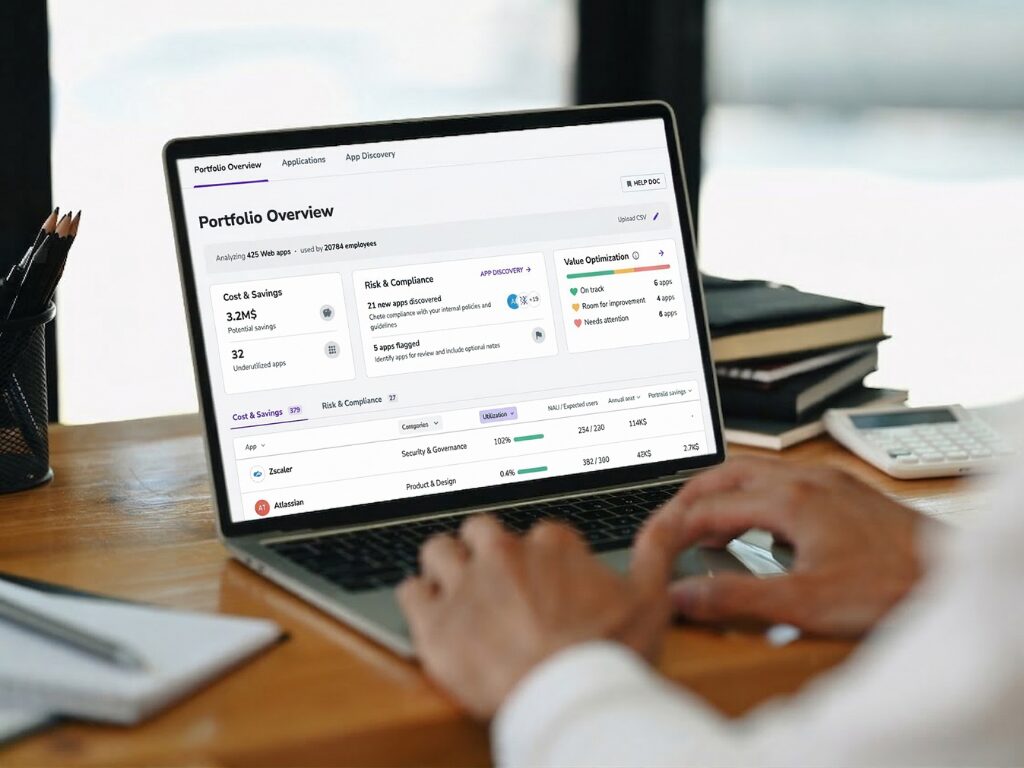
Portfolio Overview gives a cross-department view of training completion status. Instead of exporting data from the LMS into a spreadsheet before each quarterly review, the compliance team sees the full picture from one view, updated continuously.
Measure. Act. Prove.
Every deployment follows the same cycle. Measurement comes first, intervention second, proof third. The cycle repeats with each new workflow.
Measure
Userlane records every training module interaction before any intervention starts. The data shows where completion gaps concentrate, so the team acts on evidence, not assumptions.
The HEART Score, Userlane’s application health metric, captures the baseline. Every module assignment is recorded: which modules are started, which are completed, which are abandoned partway through, and where staff drop off. Nothing changes for the staff. The LMS works exactly as before.
A pattern emerges. Two departments consistently miss the annual deadline by three weeks. The attestation screen on one module type has a high abandonment rate. New starters take an average of four weeks to locate their first assigned module. The HEART Score puts a single number on each training workflow’s health.
The team sees the real problem. Not “everyone ignores compliance training.” One module has a confusing final step. Two departments have no manager follow-up on assignments. The intervention writes itself.
Act
In-app guidance, Goals, and Portfolio Overview deploy only where the measurement found gaps. Targeting the intervention is what makes the result provable.
In-app guidance activates. Only where completion drops. Staff in departments with low completion rates see step-by-step help inside the LMS when they open an assigned module. The attestation screen that caused abandonment gets a contextual prompt. Departments with high completion rates see no change.
Goals set the target. Each regulatory deadline gets a completion target by department and staff cohort. The compliance officer tracks progress against the target as the deadline approaches, not in a retrospective report after it passes.
Portfolio Overview shows the full picture. The compliance team sees completion status across every department, training type, and deadline from one view. Departments falling behind are visible before the gap becomes a regulatory finding.
Prove
The same measurement that found the problem now tracks whether the fix worked. A rising completion rate, confirmed against the organization’s own audit data, closes the loop.
The HEART Score moves. The same measurement that found the problem now tracks the fix. Module completion rates by department, training type, and staff cohort show whether the intervention worked.
Results track against the target. The goal the team set before the intervention tracks automatically. The regulatory review gets a before-and-after built from live data, not a separate report.
The cycle starts over. A new regulation adds a mandatory training requirement. The LMS vendor updates the course catalog interface. The HEART Score flags a dip. Measure, act, prove runs again. The infrastructure is already there.
Proven Impact
When in-app guidance, Goals, and Portfolio Overview replace email reminders and manual spreadsheet tracking on compliance training workflows, the results show in the organization’s own data: higher completion rates before regulatory deadlines, lower administrative burden for the compliance team, and shorter time to first module completion for new starters.
Up to 97%
Task completion rate across enterprise deployments
Up to 75%
Reduction in training time for new staff
Up to 48%
Fewer support requests after deployment
Up to 60%
Lower training costs vs. classroom methods
Frequently Asked Questions

