
Accelerating requisition approvals in hospitals
Ensure Data Quality

Req Challenge
Slow requisition approvals in hospitals are reducible at the point of submission. Most procurement systems do not guide staff through the requisition workflow efficiently.
Each purchase requisition requires item description, quantity, vendor selection, budget code, cost center allocation, and approval routing. Each field is a point where an error can stall the process. A wrong budget code sends the requisition back. A missing vendor selection triggers a manual lookup. An approval routing error sends the requisition to the wrong manager, adding days to the cycle.
The delays follow predictable patterns. A charge nurse submitting a supply order selects last quarter’s budget code because the system defaults to the previous entry. A department administrator creates a requisition for a new vendor but cannot find the vendor registration form inside the procurement system. A capital purchase request routes to the department head instead of the capital review committee because the routing rules depend on a threshold the submitter cannot see. These are not knowledge failures. The procurement system does not guide the correct submission workflow, and classroom training cannot keep pace with budget code changes, vendor additions, and threshold revisions that happen quarterly.

Our Solution
Userlane is a software adoption platform that works inside browser-based applications. For procurement workflows, it reduces requisition cycle time where delays happen: inside the procurement system, during the submission itself.
Guiding the correct submission sequence
In-app guidance walks staff through the requisition workflow that matches the order type: standard supplies, capital equipment, contracted services, or new vendor requests. Each pathway surfaces the correct budget codes, vendor selection steps, and approval routing inside the submission screen.
Catching errors before submission
Validators check each requisition as the submitter completes it. A budget code that does not match the current fiscal period, a cost center allocation that exceeds the department’s available balance, a capital purchase below the threshold routed to the capital review committee: each is flagged before the requisition is submitted, not caught during the procurement team’s review.
Tracking requisition accuracy over time
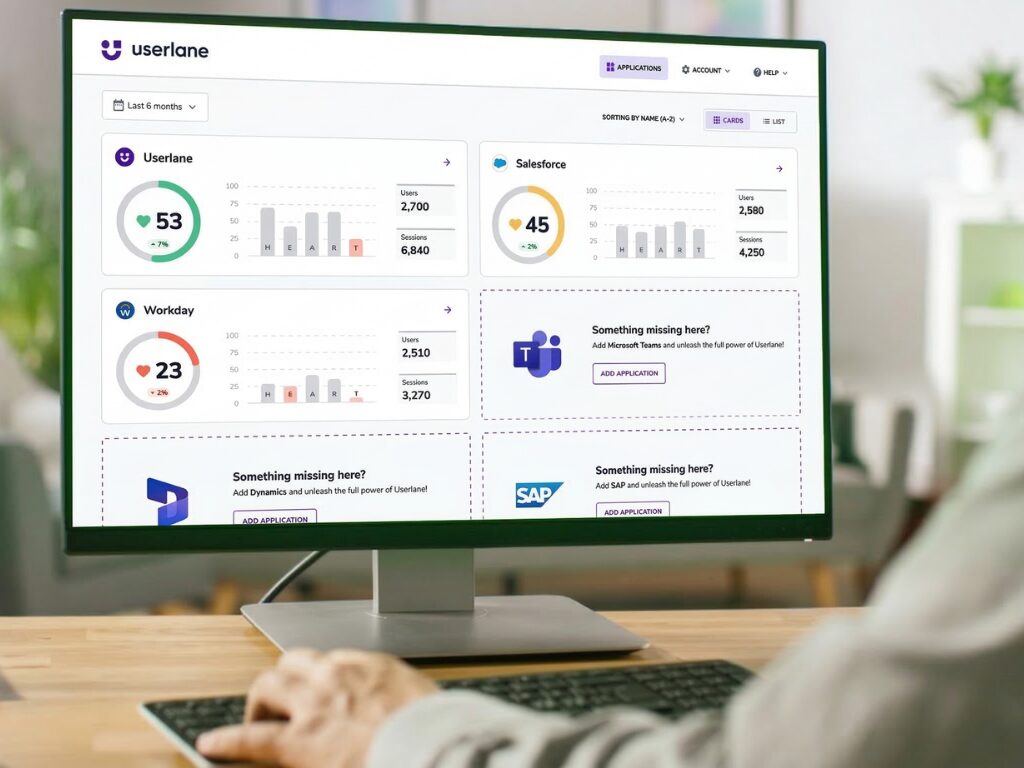
The HEART Score, Userlane’s application health metric, tracks the share of requisitions submitted correctly on the first attempt and the time from submission to approval. The procurement team sees the breakdown by department, order type, and submitter cohort: where cycle times improved and where bottlenecks remain.
Measure. Act. Prove.
Every deployment follows the same cycle. Measurement comes first, intervention second, proof third. The cycle repeats with each new workflow.
Measure
Userlane records every requisition submission before any intervention starts. The data shows where errors and delays concentrate, so the team acts on evidence, not assumptions.
Validators observe. Every requisition is recorded: which fields pass, which cause returns, where submitters navigate to external references before completing the form. Nothing changes for the staff. The procurement system works exactly as before.
A pattern emerges. Capital equipment requisitions are returned at three times the rate of standard supply orders. Budget code errors spike in the first month of each fiscal quarter. New department administrators take four submissions to get their first requisition approved. The HEART Score puts a single number on each workflow’s health.
The team sees the real problem. Not “everyone needs procurement training.” Capital requisitions need routing guidance, and Q1 submissions need updated budget codes. The intervention writes itself.
Act
In-app guidance and Validators deploy only where the measurement found delays. Targeting the intervention is what makes the result provable.
Guidance activates. Only for the order types and submitter cohorts that measured slowest. Capital equipment requests get step-by-step routing guidance. New vendor requisitions get the vendor registration pathway. Standard supply orders, which already process efficiently, see no change.
Validators catch errors. Outdated budget codes, incorrect cost center allocations, misrouted approvals: each is flagged before the requisition is submitted. Departments with low error rates see no change.
The intervention stays proportional. New administrators get submission guidance. Experienced submitters with consistent accuracy are left alone. The procurement team sees progress without waiting for the monthly cycle time report.
Prove
The same measurement that found the problem now tracks whether the fix worked. A falling return rate, confirmed against the procurement team’s own cycle time data, closes the loop.
The HEART Score moves. The same measurement that found the problem now tracks the fix. First-attempt approval rates and cycle times by department, order type, and cohort show whether the intervention worked.
Results track against the target. The goal the team set before the intervention tracks automatically. The quarterly review gets a before-and-after built from live data, not a separate report.
The cycle starts over. The organization updates its procurement policy. Budget codes change for the new fiscal year. The HEART Score flags a dip. Measure, act, prove runs again. The infrastructure is already there.
Proven Impact
When in-app guidance and Validators replace classroom training and reference documents on procurement workflows, the results show in the health system’s own data: faster requisition cycle times, fewer returns from the procurement team, and shorter time to competency for new department administrators.
Up to 97%
Task completion rate across enterprise deployments
Up to 75%
Reduction in training time for new staff
Up to 48%
Fewer support requests after deployment
Up to 60%
Lower training costs vs. classroom methods
Frequently Asked Questions

