

Thousands of doctors rotate into unfamiliar electronic patient record (EPR) systems every August. The retraining runs like clockwork. The measurement does not.
On the first Wednesday of August, around 50,000 junior doctors change posts across the NHS. Foundation year one doctors start their first clinical jobs, registrars move hospitals, and trainees rotate into trusts running EPR systems they have never used. According to Health Education England’s Doctors in Training Programme, a junior doctor can move between NHS organisations up to ten times during training. With more than 90% of trusts now running an EPR across nine or more vendor systems, many of those moves mean not just a new workplace but a new EPR to learn from scratch.
If you run an EPR training programme at an NHS trust, you already know this cycle. The training happens. But three national reports published between 2024 and 2026 confirm that no one systematically evaluates whether it works.
What the national data says
The NHS England 2024 EPR Usability Survey found that 44% of clinical staff received no ongoing EPR training at all, and fewer than four in ten said their EPR was easy to learn. The Health Foundation’s 2026 staff survey found that most EPR users had not received even basic training, with more than a quarter naming that gap as a key barrier to effective use. The HSSIB thematic review on EPR patient safety went further: training did not reflect how the system would be used in practice and was rarely delivered by people with clinical experience of the software.
Some trusts track induction through e-learning completion or mandatory sign-off checklists. Completion records attendance, however, do not answer whether a doctor rotating from an Oracle Health trust into an Epic trust can find the right patient record, order correctly, and document a consultation without workarounds on their first Monday morning. That is a competence question, and completion data cannot answer it. Vendor fragmentation makes this worse. A doctor rotating within the same deanery may move between entirely different systems at each placement.
What changes when you measure
The August rotation has three features that make it the most measurable training event in the NHS: you know who is arriving (incoming junior doctors, identifiable by rotation date), when they arrive (dates published years in advance by the UK Foundation Programme), and what system they will use (the trust’s own EPR).
That combination allows a trust to do something it cannot do with ad hoc training. It can compare a defined group’s EPR performance before and after a specific intervention on a known timeline. In practice, that means tracking EPR task completion rates in the first two weeks against weeks four to six, monitoring support tickets in the post-rotation window against the pre-rotation baseline, and capturing self-reported confidence at induction end and again two months later. None of this really requires new technology, it only requires deciding that the August induction is worth evaluating rather than just delivering.
NHS England’s digital-by-default strategy cites evidence that regular EPR training can return 50 to 60 minutes of clinical time per week. But that claim is untestable at trust level without a measurement baseline. The August rotation is the natural place to build one.
What the trust gains
A trust that measures the August rotation answers three questions its current process cannot.
First, does the EPR induction work? Not whether people attended, but whether they can use the system. If post-rotation task times do not improve, the induction content needs changing, not repeating. The Royal College of Surgeons of Edinburgh has described changeover day as a pivotal moment for patient safety. Measurement turns that moment from a risk to be managed into evidence to be used.
Second, where do support tickets come from after rotation? If your trust sees a September spike, you are not alone. Without a baseline for training effectiveness, the clinical informatics team cannot separate tickets caused by induction gaps from tickets caused by system complexity or staffing pressure. Measurement separates the signal from the noise.
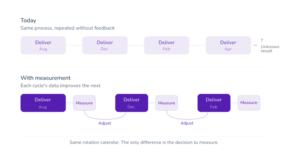
Third, what should change for the next rotation? August is the largest changeover, but secondary rotations happen in December, February, and April. A measured August induction produces a feedback loop: test a change in August, measure the result, adjust for December. Over two or three cycles, the trust builds evidence for what actually works rather than repeating what it has always done. That evidence also travels upward. A board asking whether doctors are trained on the EPR currently gets an attendance figure. A trust that measures post-rotation competence gives the board an answer about capability, which is what the question was really asking.
Looking ahead
The August rotation is the largest, most predictable training event in the NHS, and every trust that runs an EPR induction already has what it needs to measure whether that training works: a known cohort, a fixed date, and a defined system. If you run the induction this August the same way you ran it last August, you will get the same unknown result. The only thing missing is the decision to look.
How Userlane approaches this
To turn the August rotation into a measured training event, Userlane structures the process around two connected capabilities. HEART Analytics tracks adoption across five dimensions over time, providing trusts with the post-induction measurement baseline described in this piece. When the data shows where a rotation cohort struggles, Contextual Assistance delivers targeted in-app guidance inside the EPR itself, reducing dependencies on tip sheets and floorwalkers.
Related reading:

