

Copilot added 10 million seats in a single quarter. But the number that decides whether the spend is justified is usage depth, and most enterprises are not tracking it.
Microsoft 365 Copilot has reached 30 million paid seats in July 2026, adding 10 million in a single quarter and making it one of the largest enterprise AI deployments at the present moment. The number is real, however, what it reflects is not adoption but simple seat count.
A seat count records a procurement decision: someone signed an order, allocated and purchased seats. Seat growth trajectory is a legitimate market signal, however, it says nothing about whether the person assigned to that seat opened the tool this week, used it for anything meaningful, or produced work the organization could not have produced without it in a set amount of time. If you are the person presenting the Copilot renewal case to a CFO, the seat count is the one number you already have. It is also the one number that cannot answer the question you will be asked.
Why seat counts cannot answer the ROI question
Microsoft reported the seat trajectory across three consecutive earnings calls: 15 million in January, 20 million in April, 30 million in July. This acceleration demonstrates that Microsoft’s enterprise sales motion is effective, and that procurement teams are committing budget. Now that Copilot has been purchased, the main question for the organizations is how many of the seats they bought are generating the value that justified the purchase?
As of now, the answer to that question does not appear in any earnings report. Microsoft reports seats because seats are the revenue unit, enterprises track seats because seats are the number their license management system produces. Neither party reports what happens inside the application after the license is provisioned, whether the ROI is there, or whether the licenses are used to generate value.
The number nobody reports
PwC’s 29th Global CEO Survey (4,454 CEOs, 95 countries) asked chief executives whether AI had delivered financial results: 56% reported neither increased revenue nor reduced costs from their AI investments over the previous 12 months, and only 12% achieved both. Separately, a Plug and Play pulse survey of Fortune 500 and Forbes Global 2000 companies found that 74% of large enterprises now run at least one AI solution, but half of those cannot consistently measure whether it is working. The first finding is about results; the second is about measurement capability. Together, they suggest that the gap is not just in returns but in the ability to track them.
The pattern is consistent. Organizations bought the seats, and now cannot measure whether the investment is generating value, which teams use the tool and which do not, how frequently, and whether that usage translates into a workflow outcome the organization can quantify. The data that would answer those questions requires visibility into what actually happens inside the application, across teams, over time.
The usage data already exists inside the license
Microsoft already builds usage analytics into the Copilot license. The Copilot Dashboard in Viva Insights shows who uses Copilot, in which applications, how often, and at what team level. The M365 Admin Center adds active user counts, prompt activity, and app-level reporting on a 28-day cycle.
The data to answer the CFO’s question is already being collected inside the application. The problem is that most enterprises still frame renewal and ROI reports around seat count, rather than the usage data that comes with the license they already purchased.
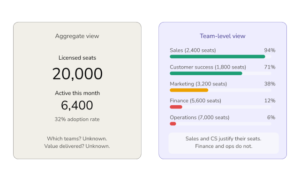
From seat count to renewal evidence
Copilot already collects the usage data, so the starting point is not more tooling but better framing. The analytics are there; what changes is how the renewal case gets built. Instead of presenting a seat count and asking for another year of budget, the team that owns the renewal can ground the conversation in what actually happened inside the application, who used it, and what it produced.
The first step could be to look at usage by team, not in aggregate. Microsoft’s 2026 Work Trend Index analyzed over 100,000 Copilot conversations and found that nearly half support cognitive work like analysis and problem-solving, while the rest splits across collaboration, producing outputs, and finding information. This suggests that the nature of AI usage varies by task type, and, by extension, across teams with different task profiles. A sales team summarizing every client meeting would generate different value than a finance team that opened Copilot once and went back to a spreadsheet. A single adoption number for the whole organization buries that difference. Breaking usage down by team turns the renewal into a portfolio decision: expand where adoption is strong, cut where it never took hold, and invest in enablement for the rest. The second step is to connect usage to a workflow outcome. “The sales team uses Copilot” is activity. “Proposal turnaround dropped from five days to two, and Copilot-assisted drafting is the mechanism” is evidence a CFO can evaluate.
There is an optional third step, and it applies beyond Copilot. Most enterprises run several AI tools alongside dozens of other applications, and the same measurement gap that makes Copilot renewals and ROI reports difficult exists across the full software estate. Measuring usage across tools rather than within one gives the renewal case more context, but it also gives the organization a consistent, evidence-based view of where any technology investment is delivering returns and where it is not.
What changes
The seat trajectory will keep climbing. The question for the teams presenting renewal cases is whether they will know which seats earned their cost and which did not.
The evidence starts with the usage data the license already collects, broken down by team and connected to the workflow outcomes those teams are paid to deliver.

